Designed by Colorado fly fishing legend John Barr, Barr’s Emerger BWO is one of the most surgically effective Blue Winged Olive imitations ever tied for Rocky Mountain tailwaters. It targets the critical transitional moment when a Baetis nymph is breaking through the surface film — the window when trout are most committed to feeding and most vulnerable to a well-placed fly.
The pattern exists in two forms: a beadhead wet version fished just below the surface, and a dry version with a trailing Antron shuck riding in the film. On the South Platte, during overcast March and April afternoons when BWOs begin emerging, this fly consistently draws up the river’s largest and most selective browns. Fish it on a long 6X fluorocarbon leader, casting upstream to actively rising fish.
Pro Tip — Timing the BWO Hatch
Blue Winged Olive hatches on the South Platte peak on overcast, drizzly afternoons — the grayer the sky, the better the hatch. Watch for the subtle dimple-rise of selective fish sipping emergers in the film and position yourself well downstream before making your first cast. A drag-free drift of even two or three feet through a feeding lane can be enough to seal the deal.
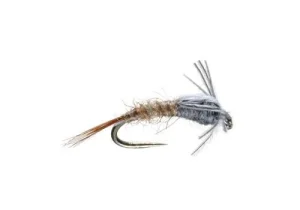
The Chocolate Thunder is a South Platte River original — a foam-wing midge emerger that sits right in the surface film, imitating a struggling midge attempting to break through the meniscus. The chocolate-brown body paired with a bright white or tan foam wing post creates a visible, convincing profile that South Platte trout key on during the heavy midge activity of February and March.
Fish it as a standalone dry during midge hatches over slow pools and glassy tailouts, or rig it as a dry-dropper with a small nymph suspended beneath it, using the Chocolate Thunder as both your fly and your indicator. The foam wing serves double duty — it floats the fly perfectly in the film and acts as a sight indicator for strike detection on long, delicate drifts. A staple of the Deckers and Cheesman Canyon midge fishery all winter and well into early spring.
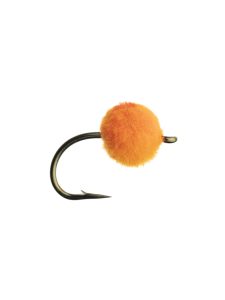
Early spring on the South Platte coincides with the white sucker spawning run, and trout key heavily on drifting eggs in the current — sometimes to the exclusion of everything else. A well-tied egg pattern fished dead-drift through deeper runs is one of the most consistently productive approaches of the entire early spring season, and one that many visiting anglers overlook entirely.
Glo Bugs in peach, chartreuse, and orange are classics, but two-toned nuclear egg variations or sucker spawn clusters in natural cream with a pink dot can be even more effective on heavily pressured fish. Weight it appropriately and dead-drift it right along the bottom through gravel runs and downstream of visible spawning activity. When the sucker spawn is on, this is often the single most productive fly in the entire river.
Tied by Colorado fly tyer Charlie Craven, the Two Bit Hooker is a precision midge and Baetis nymph imitation designed from the ground up for technical tailwater fly fishing. Two tungsten beads — one black, one silver — give it a distinctive profile and aggressive sink rate, while the slim dubbed body in olive or gray mirrors the coloration of midge larvae and early spring Baetis nymphs drifting through the South Platte’s clear flows.
The Two Bit Hooker excels as the point fly in a two-nymph Euro rig or suspension setup, especially when trout are holding tight to the bottom in slow, deep pools. The double-bead configuration creates micro-movement in the current that triggers strikes from lethargic early-spring fish who won’t chase anything. A must-have in sizes 20 and 22 for the technical slots of Cheesman Canyon and the Deckers section.
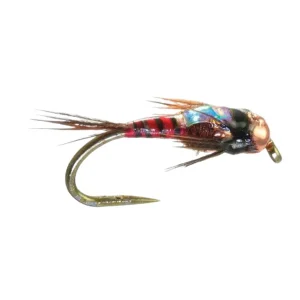
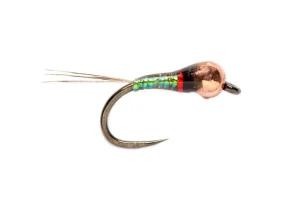
Born from the Spanish competitive fly fishing circuit and refined on the world’s most demanding trout rivers, the Perdigon (Spanish for “pellet”) has become one of the most widely adopted nymph patterns in modern tailwater fly fishing. Its UV-resin-coated body and heavy tungsten bead create an ultra-slim, ultra-fast-sinking profile that cuts through current and reaches feeding depth faster than nearly any other pattern.
On the South Platte, where early spring flows can run swift and fish hold deep, the Perdigon’s speed-to-depth advantage is decisive. It’s not a precise imitation of any single insect — it’s a triggering pattern that provokes reaction strikes through flash, compact silhouette, and sinking motion. Fish it on a Euro nymphing leader through fast riffles, pocket water, and the heads of deep pools. Olive, black, and hot orange versions all produce consistently on the South Platte.
Pro Tip — Euro Rigging the Perdigon
The Perdigon performs best in a Euro nymphing setup with a long, supple leader and no indicator. Maintain direct contact through the entire drift and watch your sighter for subtle hesitations — South Platte strikes in cold water are often barely perceptible. The Perdigon’s fast sink gets it into the strike zone before fish have time to inspect and refuse it.